AI SEO is the work of getting your business named inside the answers AI tools give, rather than only ranked on a page of Google results. It covers how your business is described across the web, whether your content can be quoted, and whether the sources these tools read say the same thing about you. It does not replace SEO. It sits on top of it.
Why does the term exist at all?
For twenty years, being found meant one thing: appearing in a list of links. The work had a name, search engine optimization, and everyone knew roughly what it involved.
Then people started asking ChatGPT, Gemini, Perplexity and Google's own AI Overviews to recommend a business. Those tools do not return a list. They return a sentence, and that sentence names two or three companies.
That is a different competition, so it acquired a different name. You will also hear it called AI visibility, answer engine optimization or generative engine optimization. The labels overlap, and we explain the distinctions in AEO vs SEO vs GEO. The underlying question is the same: when a machine answers on your behalf, does it say your name?
How does AI SEO work?
It works by changing what the web says about you, not by changing where you rank.
When an AI tool is asked to recommend a business, it draws on what it has already read: your website, your Google Business Profile, review sites, directories, industry listings, press coverage. It looks for agreement. When several independent sources describe your business the same way, the tool can answer with confidence. When they disagree, or when there is almost nothing to read, naming a competitor is safer.
- Being described consistently: the same name, location and services everywhere you appear
- Being quotable: pages that answer real questions directly, in the first two sentences
- Being machine-readable: structured data that states plainly what the business is
- Being present where these tools look: reviews, directories, local listings, genuine coverage
None of that requires a new website. Most of it happens outside your website entirely.
What is the difference between AI SEO and traditional SEO?
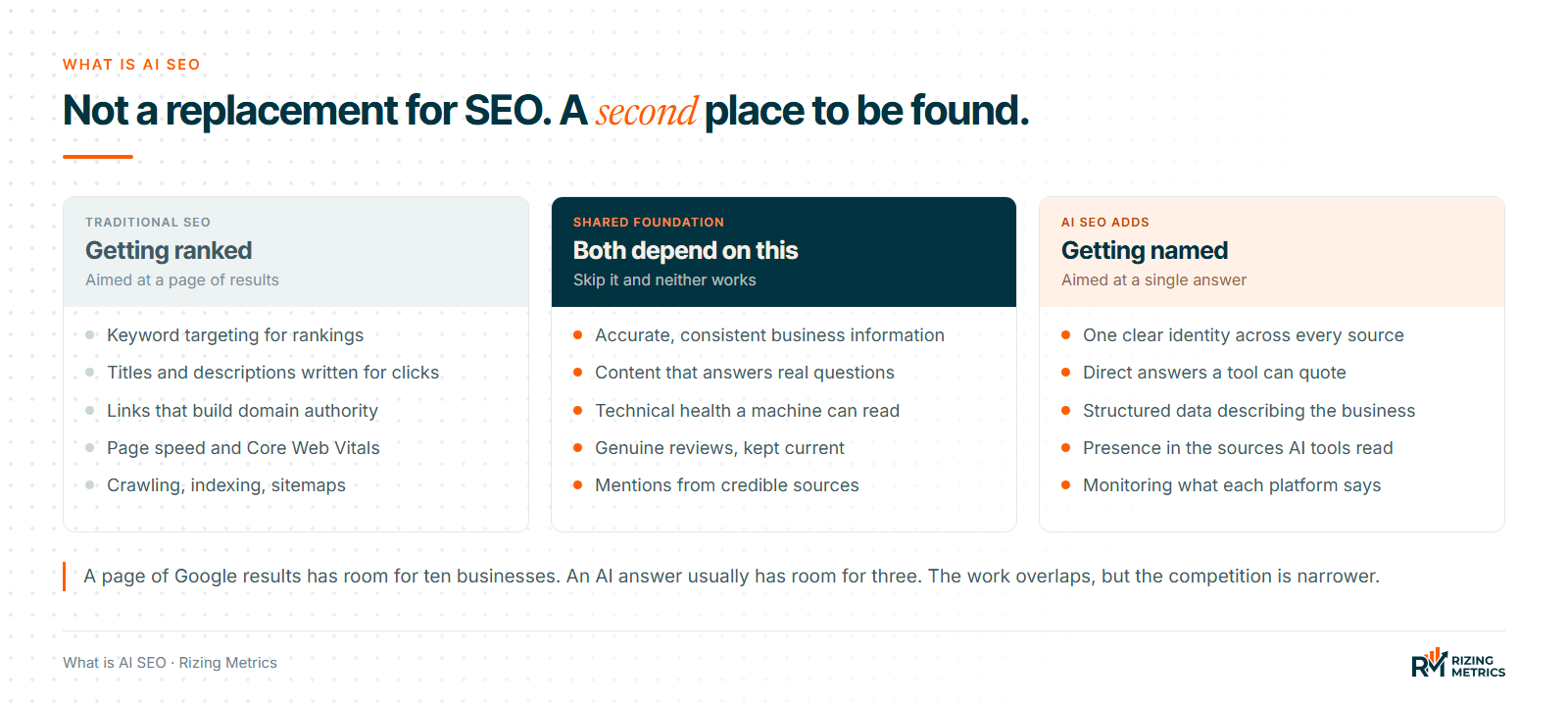
Traditional SEO aims at a page with room for ten businesses plus a map. AI SEO aims at an answer with room for three names. There is no second page and no position eleven.
The foundations are shared: accurate business information, content that answers real questions, technical health, genuine reviews, credible mentions. Neglect those and neither works. What AI SEO adds is everything to do with being understood as an entity rather than ranked as a page.
Does any of this change who gets recommended?
We tested it rather than assuming. On one day we asked ChatGPT, Gemini, Perplexity and Claude the same question: who is the best roofer near Leonardtown, Maryland. The four tools named thirteen different companies, and not one appeared on all four lists.
| Tool | What it cited as its reason |
|---|---|
| ChatGPT | Review counts, licence numbers, manufacturer certifications |
| Gemini | Google Business Profile fields: ratings, price ranges, hours |
| Perplexity | Company web pages, and a press release |
| Claude | Dedicated pages about the town, and third-party review sites |
One company was recommended specifically because it publishes a local blog. Another, the only one named by three tools, was cited through a press release. The full results are in our study of how local businesses get found in AI search. Two conclusions follow: AI SEO is real work with visible causes, and no single fix gets you named everywhere.
Is AI SEO worth doing yet?
That depends on where your customers ask their questions. Whitespark tested 540 local business queries across six industries and found AI Overviews appearing for 15 percent of purely local searches such as "plumber near me", but for 92 percent of informational searches and 97 percent of hybrid ones.
So the moment of intent still mostly returns a map. The research that happens first, when a customer is deciding who is worth calling, now usually returns an AI answer. If you sell anything a customer researches before buying, you are already affected.
What AI SEO is not
It is not paid placement. There is no advertising slot inside an organic AI recommendation, and any company selling guaranteed placement is not describing how these systems work.
It is not a replacement for SEO. Google still drives most local traffic, and a business that abandons search fundamentals to chase AI answers will lose more than it gains.
It is not a one-time project. These systems update continually, and answers shift without anything on your website changing.
It is not guaranteed. Nobody can promise that a given tool will name you, and results vary by platform, phrasing, location and date.
What should you fix first?
| Fix | Effort |
|---|---|
| Complete your Google Business Profile: category, services, hours, service area | 1 hour |
| Put licence numbers and certifications on your website | 30 minutes |
| Make your business details identical everywhere they appear | 1 afternoon |
| Answer your real customer questions on your site, answer first | Ongoing |
| Get listed where these tools read: Bing, Apple, industry directories | 2 hours |
| Ask every customer for a review, every month | Ongoing |
Only one of those six involves writing new pages, and none involve redesigning a website. In our four-platform test, no tool mentioned how a website looked. They quoted what the sites said.
How do you know if it is working?
Ask the tools directly, in the words your customers use, and repeat it monthly. Note which platforms name you, which name competitors, and what reason each gives. That reason is usually the instruction for what to fix next.
Rankings and traffic still matter, and Search Console still reports those. AI visibility needs its own check, because nothing in your analytics reports a conversation that happened inside ChatGPT. You can run a free AI visibility audit to see where your business stands across Google and the major AI platforms.
Who should be doing this work?
If someone already handles your SEO, this belongs with them, because the foundations are shared and splitting them across two suppliers creates contradictions in exactly the information these tools compare.
If you are doing it yourself, work through the six fixes above in order. Most of the value sits in the first three, and none of them need a developer.
If you want it handled, that is what our AI visibility optimization service covers. Rizing Metrics is an AI SEO agency in Maryland working with businesses across St. Mary's, Calvert and Charles counties and with companies throughout the United States.