
You decide your business needs to appear when customers ask AI tools for recommendations. You start looking for help. Ten minutes later you have found an AEO agency, a GEO agency, an LLM SEO agency, an AI SEO agency and an “answer engine specialist”. Every one of them describes what looks like the same service, and every one of them quotes a different price.
None of them explain how they differ from each other. Several imply that the others are already obsolete.
This article gives you the honest version: what each term means, where the differences are real, where they are marketing, what the work costs, and how to judge an agency before you sign anything.
What is the difference between an AEO agency, a GEO agency and an LLM SEO agency?
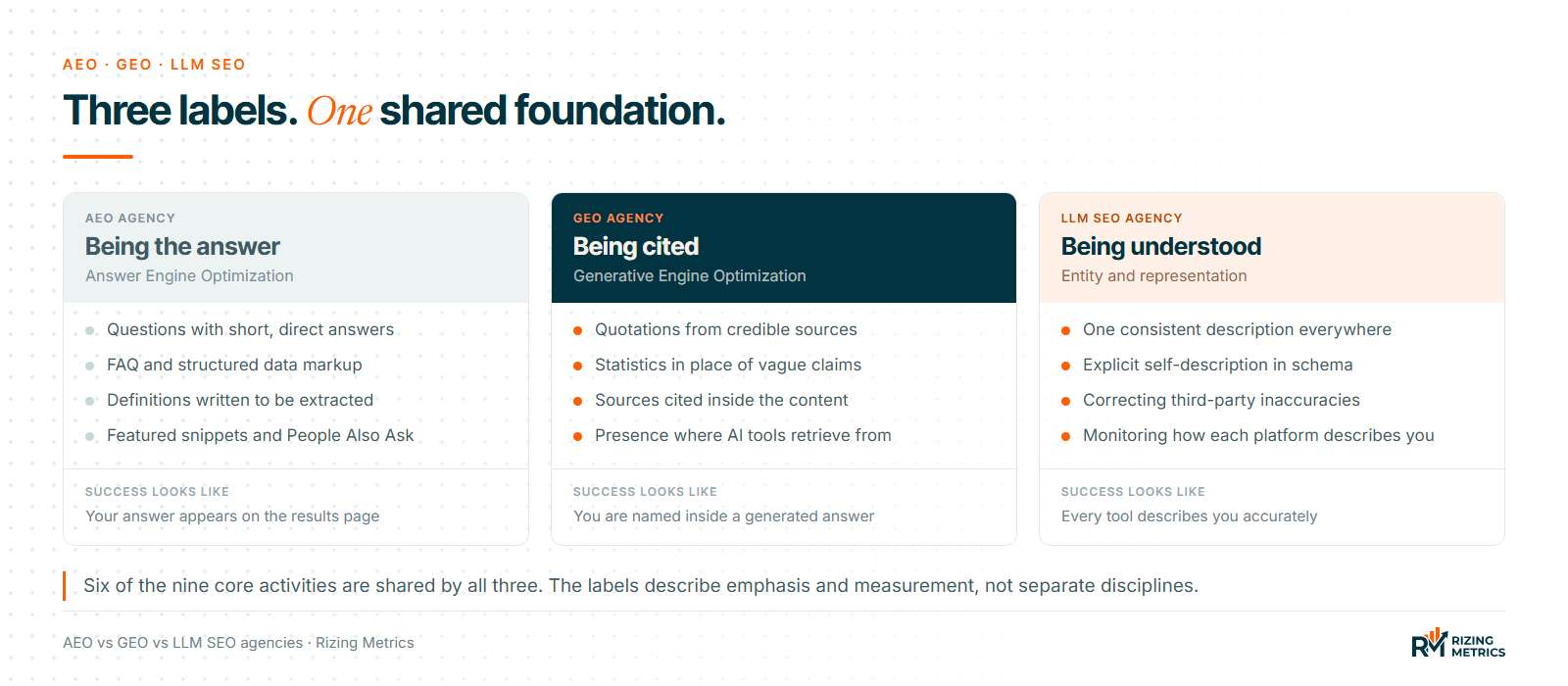
Very little separates them in practice. AEO focuses on winning direct answers, GEO focuses on being cited inside AI-generated responses, and LLM SEO focuses on how language models understand and describe your business. The underlying work stays largely the same, because all three depend on accurate information, structured data and credible sources. The labels describe emphasis rather than separate disciplines.
That is the answer most agency websites will not give you, because the overlap is inconvenient to sell. The differences are real, yet they are differences of focus rather than of method. Here is what each term genuinely means.
What does an AEO agency do?
AEO stands for Answer Engine Optimization. It is the oldest of the three terms and predates generative AI entirely.
It grew out of a shift that began years before ChatGPT. Google started answering questions directly on the results page through featured snippets, People Also Ask boxes and knowledge panels, and voice assistants began reading a single answer aloud instead of offering a list of links. The goal of AEO is to be the answer rather than a result.
An agency describing itself as an AEO agency is usually strongest on content structure and on-page markup. The work looks like this:
- Content structured as questions with short, direct answers beneath them
- FAQ and structured data markup so machines can parse the question and the answer as a pair
- Concise definitions written to be extracted, not only read
- Targeting featured snippets and People Also Ask placements
We cover how these disciplines differ from traditional search work separately in AEO vs SEO vs GEO.
What does a GEO agency do?
GEO stands for Generative Engine Optimization. Unlike the other two terms, it has a documented origin and measured results behind it.
Researchers introduced the term in a November 2023 paper from IIT Delhi, Princeton, Georgia Tech and the Allen Institute for AI, later published at ACM SIGKDD 2024. They modelled a generative engine as two parts. Retrieval finds the sources, and synthesis writes the answer. They then built a benchmark and tested nine content optimization methods against it.
Three methods stood out:
| Method tested | Visibility improvement |
|---|---|
| Adding quotations from credible sources | 41 percent |
| Adding statistics in place of qualitative claims | 32 percent |
| Citing sources | 28 percent |
Keyword stuffing, the traditional SEO instinct, was among the nine methods tested and did not reach the top three.
One finding from that paper deserves far more attention than it receives, particularly for a business that is not already the best-known name in its market. Citing sources improved visibility by 115 percent for websites sitting at position five, while reducing visibility by 30 percent for sources that were already top-ranked. The same technique that lifts a challenger can suppress a leader.
That finding gives a smaller business the strongest available argument for doing this work at all. Traditional search rewards accumulated authority, which means the established name keeps winning. Generative search behaves differently, because well-evidenced content from a lesser-known source can outperform a bigger name that asserts things without support.
Note - The 40 percent improvement figure quoted on many agency websites comes from this published benchmark rather than from that agency’s own client results. Any agency presenting it as its own outcome is misrepresenting published research.
What does an LLM SEO agency do?
LLM SEO is the newest of these terms and the least standardised. No founding paper exists, no agreed definition exists, and no consensus exists on what the work includes. That absence of definition is precisely why these offers deserve the closest reading.
AEO asks whether you will be the answer. GEO asks whether you will be cited. LLM SEO asks a different question altogether: does the model actually know what you are?
The three layers, and what you can influence
| Layer | What it is | Can you influence it? |
|---|---|---|
| Training data | Text the model learned from, fixed at training time | No. Not by any means, at any price |
| Retrieval | Sources the model fetches live when it searches | Yes. This is where the work happens |
| Representation | How the model describes your business when asked | Indirectly, by controlling what your sources say |
That first row deserves a direct statement. Training data is assembled before a model ships, from sources you do not control, and it cannot be edited afterwards. Any agency offering to place your business inside an AI model’s training data is either confused about how these systems work or dishonest about what it can deliver. That offer is the clearest disqualifying signal in this category.
What the legitimate work looks like
- Entity consistency, meaning one description of your business, with the same name, address, phone number and services, across your website, your profiles, directories and citations. Models synthesise across sources, and contradictions make them hedge or leave you out
- Explicit self-description in structured data, stating plainly what you are, where you operate and what you offer, in a format that requires no inference
- Correcting third-party inaccuracies, because outdated addresses, old phone numbers and former business names persist in the sources models read long after you have corrected your own site
- Monitoring representation rather than mentions alone. Being named is one thing. Being described correctly is another, and only the second one wins you customers
How to test your own representation today
Ask three different AI tools the same question: what does your business do? Then check three things:
- Do they describe you accurately?
- Do they agree with each other?
- Do they confuse you with a similarly named company?
Inconsistent answers point to an entity problem, and no amount of content production fixes that until the underlying information agrees with itself.
Where do the three actually overlap?
| Work | AEO | GEO | LLM SEO |
|---|---|---|---|
| Accurate, consistent business information | Yes | Yes | Yes |
| Structured data and schema markup | Yes | Yes | Yes |
| Question-form content with direct answers | Core | Yes | Yes |
| Quotable statistics and cited sources | Yes | Core | Yes |
| Third-party mentions and reviews | Yes | Yes | Yes |
| Crawlability for AI user agents | Yes | Yes | Yes |
| Featured snippet targeting | Core | No | No |
| Entity consistency across the web | Yes | Yes | Core |
| Monitoring what each platform says about you | Yes | Yes | Yes |
Six of the nine activities are shared by all three. The distinctions sit in the emphasis, and in what gets measured.
Are these actually different services?
Mostly they are not. The foundation is shared, because all three depend on clear information, structured data, content that answers real questions, and credible third-party sources. Genuine differences appear only in emphasis and measurement, meaning which platforms get tracked and whether success counts as a snippet, a citation or an accurate description.
An agency doing any one of these properly is already doing most of the other two. An agency telling you that these are three separate products requiring three separate retainers is selling you the same work three times.
What we found when we audited the agencies ranking for these terms
Rather than take anyone’s word for it, we checked the structured data on three agency websites currently ranking on page one for AI SEO terms in our market.
| Site | Word count | FAQ schema | Sells AEO or AI search services |
|---|---|---|---|
| Agency A | 942 | None | Yes |
| Agency B | 694 | No schema at all | Yes |
| Agency C | 796 | Yes | Yes |
Two of the three sell answer engine optimization while implementing none of the markup that makes an answer machine-readable. One of them had published nine FAQ questions on the page and marked up none of them.
This is the most practical test you can run before hiring anyone, and it takes two minutes:
- Open the agency’s own homepage
- Right-click and choose View Page Source
- Search the source for application/ld+json
An agency selling AI visibility that has not structured its own data has not done this work before. You would be its experiment.
Why does the industry use so many different names?
Three reasons explain it, and only one of them is about you.
- The terms were coined independently. AEO came out of search marketing around voice and featured snippets, GEO came out of academic research, and LLM SEO emerged from practitioners. They were never designed as a coherent set
- No standards body governs this vocabulary. Any agency can define these terms however suits its offer, and many do
- A new name is easier to sell than a track record. Almost nobody in a field this young has multi-year results, and naming the category yourself is a way to appear to lead it
That last reason is worth remembering when you compare proposals.
What does this work cost, and how is it priced?
Three models exist, and the structure tells you more than the number does.
| Model | How it works | Best for |
|---|---|---|
| Monthly retainer | Ongoing work, reported monthly | Most businesses, since this is genuinely ongoing work |
| One-off audit | Assessment and roadmap, which you implement | Businesses with an in-house team |
| Audit then retainer | Paid audit first, retainer if you proceed | Testing an agency before committing |
Four factors drive the price:
- How much of the foundation already exists, because a site with clean structured data and consistent business information needs far less remediation
- How many locations and services need covering
- Whether content production is included or you supply it
- Whether ongoing measurement across platforms is included, which is labour-intensive when done properly
Offers priced well below the market are almost always templated, using the same page structure with your city dropped into it. Premium pricing, meanwhile, is only justified by measurement. Any agency charging enterprise rates should be able to tell you which queries it tracks and what your baseline is. An agency that cannot is charging you for positioning rather than for work.
Note - One question settles it: ask what the first thirty days include. A credible answer describes an audit, a baseline measurement and a prioritised fix list. A vague answer means your engagement has not been planned yet.
Which type of agency do you actually need?
Work backwards from your goal rather than from the label.
| Your goal | What to prioritise |
|---|---|
| Appear in Google’s AI Overviews and featured snippets | AEO emphasis, covering content structure and markup |
| Be named by ChatGPT, Perplexity or Claude | GEO emphasis, covering quotable and well-evidenced content |
| Be described accurately by AI tools | Entity work, meaning consistency across every source |
| Still be found in ordinary Google search | Traditional SEO, which underpins all of it |
| All of the above | A single AI SEO agency covering the full scope |
Most businesses land on the last row, and for a practical reason. Splitting this work means several agencies editing the same pages, the same schema and the same business information. Inconsistency is the exact problem this work exists to solve, and dividing the work is how inconsistency gets introduced.
When splitting genuinely is the right call
- You already have a capable SEO agency you trust. Do not replace them. Add a specialist for AI visibility and entity work, and make sure both teams agree on who owns your structured data
- You are an enterprise with an in-house SEO team. Keep the foundation internal and bring in a specialist for the AI-specific layer
- You operate in a regulated industry where content needs compliance review regardless, so a separate content partner may already be non-negotiable
Each of those cases still requires one team to own the structured data and the business information. Split the strategy if you must. Never split the entity.
What should you ask before hiring any of them?
Five questions separate genuine practitioners from rebranded ones.
- Which platforms will you measure, and how? A real answer names specific tools and a repeatable set of queries. A vague answer means nothing is being measured
- What does my baseline look like today? An agency that has not measured where you currently stand cannot show improvement later
- Can you show me a before and after on your own website? An agency that cannot make itself visible in AI search has not done this before
- What are you doing that traditional SEO does not already cover? An agency that cannot answer specifically is charging a premium for standard SEO
- What happens when a platform changes how it selects sources? The honest answer involves strengthening fundamentals, not a proprietary trick
Six red flags are worth watching for, in rough order of seriousness:
- Guaranteed ChatGPT rankings or guaranteed AI recommendations
- Any offer to place your business inside an AI model’s training data
- AI named as a buzzword with no described method behind it
- No measurement approach at all
- Statistics from published research presented as their own client results
- No verifiable clients, case studies or reviews
How do you know whether any of it is working?
Track mention rate rather than position. Build a fixed set of questions a customer would realistically ask, run them across each platform on a schedule, and record how often your business is named. One query checked once proves nothing, because AI answers vary between sessions, accounts and locations.
Two free sources are worth using:
- Bing Webmaster Tools reports AI performance data, including Copilot activity. The Bing index feeds Copilot, which makes this the most direct free signal available
- Google Search Console shows impressions and average position, though Google does not fully separate AI Overview appearances from ordinary results, so treat it as directional
Manual tracking against a fixed query set on a fixed schedule remains the most reliable method available. Anyone offering a precise AI visibility score should be asked exactly how that score is calculated.
The label matters less than the method
AEO, GEO, LLM SEO and AI SEO are four names for largely overlapping work. The vocabulary will settle eventually, and some of these terms will not survive.
What will not change is the thing that actually makes a business appear in AI answers: information a machine can read without ambiguity, content that answers real questions directly, and enough credible third-party evidence that a model is confident naming you.
Judge an agency on whether it does that work and can measure it, rather than on which acronym it chose. Rizing Metrics is an AI SEO agency covering answer engine optimization, generative engine optimization and entity work as a single scope, because in practice they are one job. Our answer engine optimization service shows how that breaks down.